
Iosco County Arrest Records and Court Charges
An Iosco County arrest record documents the arrest event. It shows who was taken into custody, the arresting agency, the booking, and the offense the officer listed at the time. The Iosco County Sheriff's Office and the county jail hold that booking side. An arrest by itself is not a charge. Once a person is booked, the county prosecutor reviews the matter and decides the formal court charges. Those charges are filed with the court, and that filing is what becomes the charge record the courts track from start to finish.
The two records live in different places. Arrest and booking detail sits with the sheriff and jail, and custody status for a person held in the Iosco County Jail is confirmed through the sheriff's office. Court charges after arrest sit with the district court or circuit court, depending on the offense. For the jail side and booking information, the county inmate records page is the better starting point. For the full case file, pleas, and sentence, the criminal court records page carries the outcome once a charge is resolved.
How to Find Iosco County Arrest Records and Charges
Court charges show up in the county's case-search and payment portals, not in a single arrest index. The 81st District Court handles misdemeanors, traffic charges, civil infractions, and the early stages of felony cases, and its online payment portal lets the public search by a defendant's name and date of birth, by citation number, or by case number. The 23rd Judicial Circuit Court handles felony charges once they move up, and it offers both a court payment search by name and date of birth and a circuit case-search route. The statewide MiCOURT system is the broad cross-check across court types. Booking detail from the arrest itself stays with the jail.
- Open the district court payment portal for a misdemeanor, traffic, or civil-infraction charge, or the circuit court search for a felony matter.
- Search by the defendant's name and date of birth, or by the citation or case number when it is known.
- Open the matching case to see each charge listed against the defendant.
- Check every charge for its statute code, its level, and its current status.
Some records will not appear online. Both the district and circuit portals note that non-public cases cannot be paid or viewed online, so a blocked search does not always mean the record is missing. To confirm whether a person is held in the Iosco County Jail and what bond or fines are owed, the jail line at (989) 362-6164 is the direct route, though staff can share only whether the person is lodged and the bond or fine amount. Families reaching someone already booked can set up phone talk time through the jail's InmateSales account portal.

That custody service sits apart from the court charge record, which is why an Iosco County arrest records search often means checking both the jail and the court case. When a charge record or arrest report is not posted online, a Michigan FOIA request under MCL 15.231 to the office that holds it is the fallback.
How Iosco County Charges Are Filed: Complaint, Information, and Indictment
The charge record begins after the arrest, not during it. Once a person is booked, the prosecutor decides what to file and starts the case with a charging document. Michigan uses three kinds, but two of them do almost all the work. Most cases open with a complaint, and felonies that move forward are charged by an information. A grand-jury indictment is possible but rare in Michigan practice.
| Complaint | Information | Indictment | |
|---|---|---|---|
| Filed By | Prosecutor or officer | Prosecutor | Grand jury |
| Common For | Misdemeanors and the start of felony cases | Felonies bound over to circuit court | Rare in Michigan |
| Starts | The case in district court | The felony case in circuit court | A case by grand jury |
A felony often begins in the 81st District Court with a complaint and warrant. The district judge then holds a preliminary examination to test whether enough cause exists. If it does, the felony is bound over to the 23rd Judicial Circuit Court, where the prosecutor files the information that carries the charge forward. That bind-over step is why a single charge can appear first in district court records and later in circuit court records.
Charge Status and What It Means
A charge is not fixed once it is filed. As the case moves, a charge can be amended, reduced, added, dropped, or dismissed. The status field in a case record is often the most useful part for someone tracking court charges after arrest, because it shows where a charge stands right now. The terms below are the ones that appear most often in Iosco County case records.
| Status | What It Means |
|---|---|
| Pending | The charge is filed and active while the case moves through the court. |
| Amended | The prosecutor changed the charge, its statute, or its wording after filing. |
| Reduced | The charge was lowered to a less serious offense, often through a plea. |
| Dismissed | The court dropped the charge, so it no longer moves toward a conviction. |
| Nolle prosequi | The prosecutor formally chose not to pursue the charge. |
| Bound over | A district judge found enough cause to send a felony charge up to circuit court. |
Note: A dismissed or nolle prosequi charge still leaves a record of the arrest and the filing, even though it never reached a conviction.
Charges vs. Convictions in Iosco County
Being charged is not the same as being convicted. A charge is an accusation that a prosecutor believes there is cause to file. A conviction comes only after a plea or a verdict, and it requires a much higher level of proof. This gap matters when reading arrest records, because an arrest and a filed charge can sit in the record even when the case ends without a conviction.
| Charge | Conviction | |
|---|---|---|
| Stage | Accusation | Verdict or plea |
| Burden of Proof | Probable cause | Beyond a reasonable doubt |
| Public Record | Yes | Yes |
Sealed vs. Expunged Records
Michigan handles record cleanup mostly through a process called set-aside, which most people know as expungement. A sealed record is withheld from the public index by a court order or rule, but it still exists. An expunged, or set-aside, record is removed from the public record so it no longer shows up in a standard search. Some records qualify for set-aside by petition, and others clear on their own under the state's automatic expungement law.
| Sealed | Expunged (set aside) | |
|---|---|---|
| Visibility | Withheld from the public index | Removed from the public record |
| Law Enforcement | Still visible to courts and police | Kept in a nonpublic file for limited use |
| Eligibility | By court order or rule for confidential matters | Petition under MCL 780.621 or automatic expungement |
A different route applies to some first-time drug charges. Michigan allows a deferral under MCL 333.7411, which can keep a controlled-substance charge off the public record if the person completes the terms the court sets. Deferred outcomes like that are one reason a charge may show as dismissed rather than convicted.
Charge Codes and Severity Levels in Iosco County
Each charge in a case record ties to a Michigan Compiled Laws statute, and that code tells you both the offense and its level. Michigan sorts offenses into three broad tiers. A felony carries the heaviest exposure and moves into circuit court. A misdemeanor is less serious and usually stays in the 81st District Court. A civil infraction, such as a routine traffic violation, is not a crime at all and is handled as a ticket with a fine.
District court jurisdiction over those lower tiers comes from MCL 600.8311, which sets its misdemeanor and civil-infraction authority. One arrest can produce several separate charges at once. A single traffic stop, for example, might list a misdemeanor charge, a civil infraction, and an added count, each with its own statute code and its own status as the case moves.
Statewide Charge and Criminal History Lookups
Charges filed in Iosco County also roll up into the statewide court system. The MiCOURT case search is the broadest official public tool, and it can surface case information, documents, orders, and opinions depending on the court type. The visible search fields include Case Number, Party Name, Attorney Name, Bar Number, Lower Court, and Appellate Court, which lets a search cross-check a charge across district and circuit levels.
A statewide case search is not the same as a full criminal history report. Some records are non-public by court rule, and MiCOURT will not show them. When a person needs a formal record that is not posted online, the fallback is a written request to the office that holds it, filed under Michigan's Freedom of Information Act. The county publishes its own FOIA forms for that purpose.
Background Check Considerations
A casual charge lookup and a formal background check are two different things. Reading a case in MiCOURT or a county portal is fine for personal knowledge, curiosity, or checking the status of a matter you are part of. A background check used to make a decision about hiring, housing, credit, or insurance is governed by federal law. Those checks must run through a licensed consumer reporting agency that follows the Fair Credit Reporting Act.
Important: This website is not a consumer reporting agency under the Fair Credit Reporting Act, and its records cannot be used for employment, housing, credit, or insurance screening.
Restricted Charge Records in Iosco County
Not every charge record is open to the public. Michigan law keeps several categories out of a standard search. Juvenile matters carry the strongest limits, and much of what the public can see is controlled by court order. Sealed and set-aside charges drop from the public index. Some dismissed charges are withheld, and records tied to an ongoing investigation are held back until the matter closes.
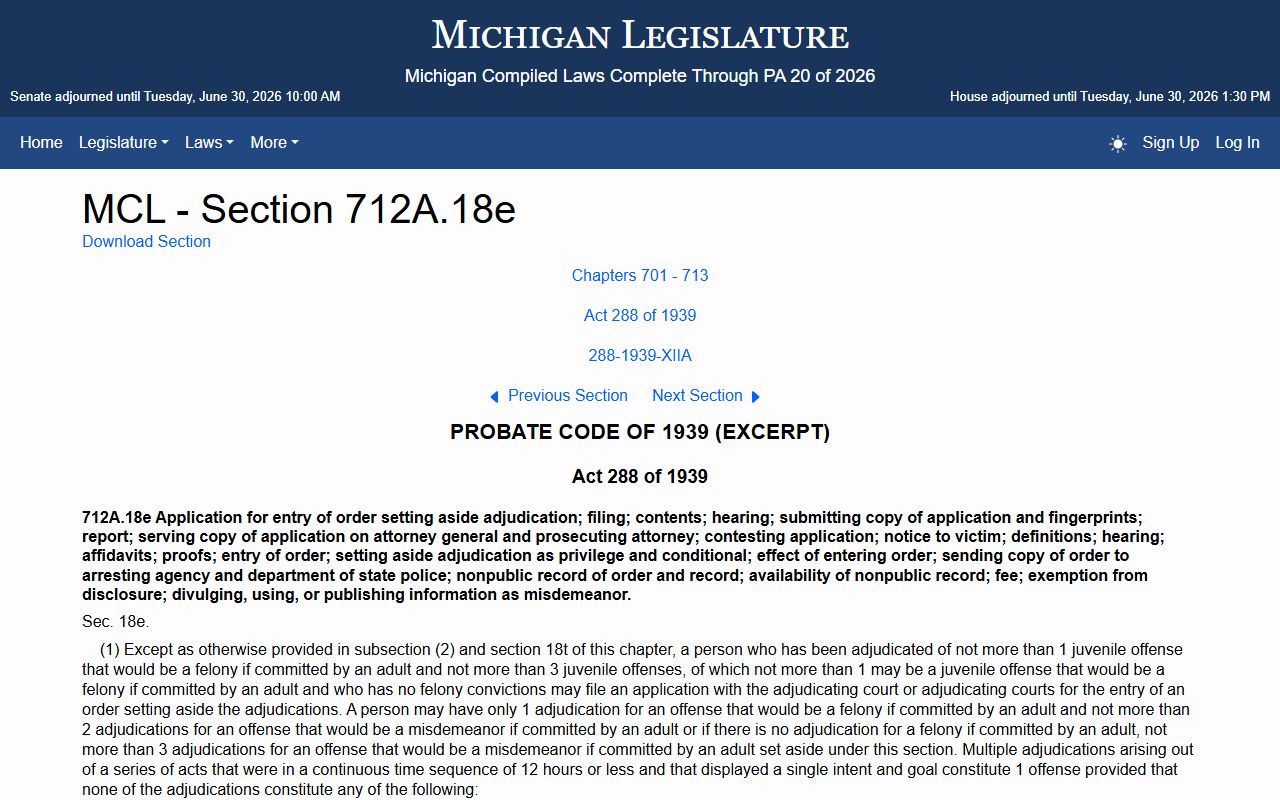
Michigan sets tight limits on juvenile charge records, and the process for setting aside a juvenile adjudication runs through MCL 712A.18e.
Because the county publishes no single arrest-charge index, a restricted or non-public record often calls for a direct step. The right move is to call the office that owns the record, use the correct court portal for the case type, or file a Michigan FOIA request when the record is not available online. No public listing does not mean no public record.