
Criminal Court Records in Iosco County
A criminal court record is the case file an Iosco County court opens the moment charges are filed. The Iosco County Clerk, Nancy J. Huebel, keeps the circuit court's files, and she also serves as clerk of the circuit court. District court staff hold the district files. Each record starts with the charging document and grows as the case moves. Every motion, hearing notice, plea, and order lands in the same file. By the end, it shows the charges, the plea or verdict, the disposition, and the sentence. That paper trail is what most people mean when they ask for a criminal record at the courthouse on West Lake Street in Tawas City.
Two courts share criminal work in Iosco County. The 81st District Court, led by Judge Christopher P. Martin, handles misdemeanors and the early stage of felony cases. It hears arraignments, sets bond, and holds the preliminary examination that tests whether a felony has enough proof to go forward. The 23rd Judicial Circuit Court, with Judge David C. Riffel, takes felony cases after bindover, along with serious misdemeanors and appeals from the district court. State law sets that split. MCL 600.8311 grants the district court its criminal reach, while the circuit court draws its authority from MCL 600.601.
How to Search Iosco County Criminal Court Records
Most Iosco County criminal case searches start online. The statewide MiCOURT case search is the broadest official tool, and it can show case information, documents, orders, and opinions, depending on the court. The county also links a direct 23rd Circuit Court case search route. For fines and case lookups tied to the district court, the district payment portal lets users search by name and date of birth or by citation and case number.
- Open the MiCOURT case search or the county's circuit court route.
- Enter the defendant name or the case number. The tool also accepts party name, attorney name, bar number, and lower court.
- Narrow the results by court, case type, and filing date to reach the right file.
- Open the case to read the docket, the charges, and the disposition.
- Ask the Iosco County Clerk for a certified copy when an official version is needed.
The circuit court payment portal adds another lookup route for circuit matters. It accepts a case number or a name with date of birth, and it explains the county case-number format as year, case code, and type. Balances can lag a day or two after a payment posts, so the amount shown may trail the current total.
Not every file sits online. Non-public cases are blocked by design, and the district portal warns that those cannot be paid or viewed the same way. When a search comes up empty, the next step is a call to the court office that owns the file, or a records request to the office that holds it.
Note: Some Iosco County criminal matters are split across two courts, so a full case history may mean checking both the district and circuit search routes.
Stages of an Iosco County Criminal Case
A criminal case in Iosco County follows a set path, and each step leaves its own mark in the record. Felonies begin in the district court and often finish in the circuit court, so an Iosco County criminal file can span two courts. Misdemeanors usually stay in the district court from start to end. The file grows at every stage, so a reader can trace the matter from the first charge to the final sentence.
Case flow: Charges Filed › District Court Arraignment › Preliminary Examination › Bindover to Circuit Court › Circuit Arraignment › Pretrial › Plea or Trial › Sentencing
| Stage | What Happens |
|---|---|
| District Court Arraignment | The 81st District Court reads the charges, sets or reviews bond, and records the first plea. |
| Preliminary Examination | For a felony, the district court weighs the proof to decide whether the case should move up. |
| Bindover to Circuit Court | When the proof clears that bar, the case transfers to the 23rd Circuit Court for trial-level work. |
| Circuit Arraignment | The circuit court restates the felony charges and confirms the defendant's plea and counsel. |
| Pretrial / Motions | Lawyers exchange evidence, file motions, and often discuss a plea before any trial date. |
| Plea or Trial | Most cases end in a plea; the rest go to a judge or jury for a verdict. |
| Sentencing | The judge imposes the penalty and enters the final disposition into the record. |
What an Iosco County Criminal Court Record Shows
An Iosco County criminal court record reads field by field. The header names the court and the case, and the body tracks each event in order. Knowing what each field holds makes the file far easier to follow, whether it sits in the district court or the circuit court. The charges themselves get a closer look on the Iosco County arrest records and court charges page.
| Field | What It Shows |
|---|---|
| Case Number | The court's tracking code, written in the year-code-type format the county uses for lookups. |
| Defendant | The person charged, listed with identifiers the court uses to keep files apart. |
| Charges | Each count as filed, with the statute cited and the severity, from civil infraction to felony. |
| Plea | The defendant's answer to each count, such as guilty, not guilty, or no contest. |
| Disposition | How each count ended, whether by plea, verdict, dismissal, or transfer. |
| Sentence | The penalty imposed, which can include jail, probation, fines, costs, or restitution. |
Charges vs. Convictions
Being charged is not the same as being convicted, and an Iosco County criminal record keeps the two apart. A charge is the accusation a prosecutor files. A conviction is the finding of guilt that follows a plea or a verdict. An Iosco County criminal file can show charges that were later dropped, dismissed, reduced, or ended in acquittal. Readers should check the disposition on each count before drawing any conclusion. The count number and the outcome sit side by side in the docket for exactly that reason.
| Charge | Conviction | |
|---|---|---|
| Stage | Accusation | Verdict or plea |
| Burden of Proof | Probable cause | Beyond reasonable doubt |
| Public Record | Yes | Yes |
Reading Dispositions and Sentences
The disposition line is where a case reaches its end, and the wording matters. Guilty and not guilty are the plainest outcomes. Dismissed means the count was dropped. No contest, or nolo, accepts the penalty without an admission of guilt. Some cases end in a deferral, where the court holds the matter open and may clear the charge if the defendant meets set terms. A sentence can stack several parts, so the record may list jail time, probation, fines, court costs, and restitution together.
Reading the sentence takes care. A term may run in the county jail or, for a felony, in state prison. Probation can carry conditions such as testing, treatment, or supervision. A single case can end with a mix of these on different counts, so the record should be read count by count rather than as one flat outcome.
Michigan offers one such deferral for certain first-time drug offenses under MCL 333.7411, which can keep a conviction off the public record when the terms are met.
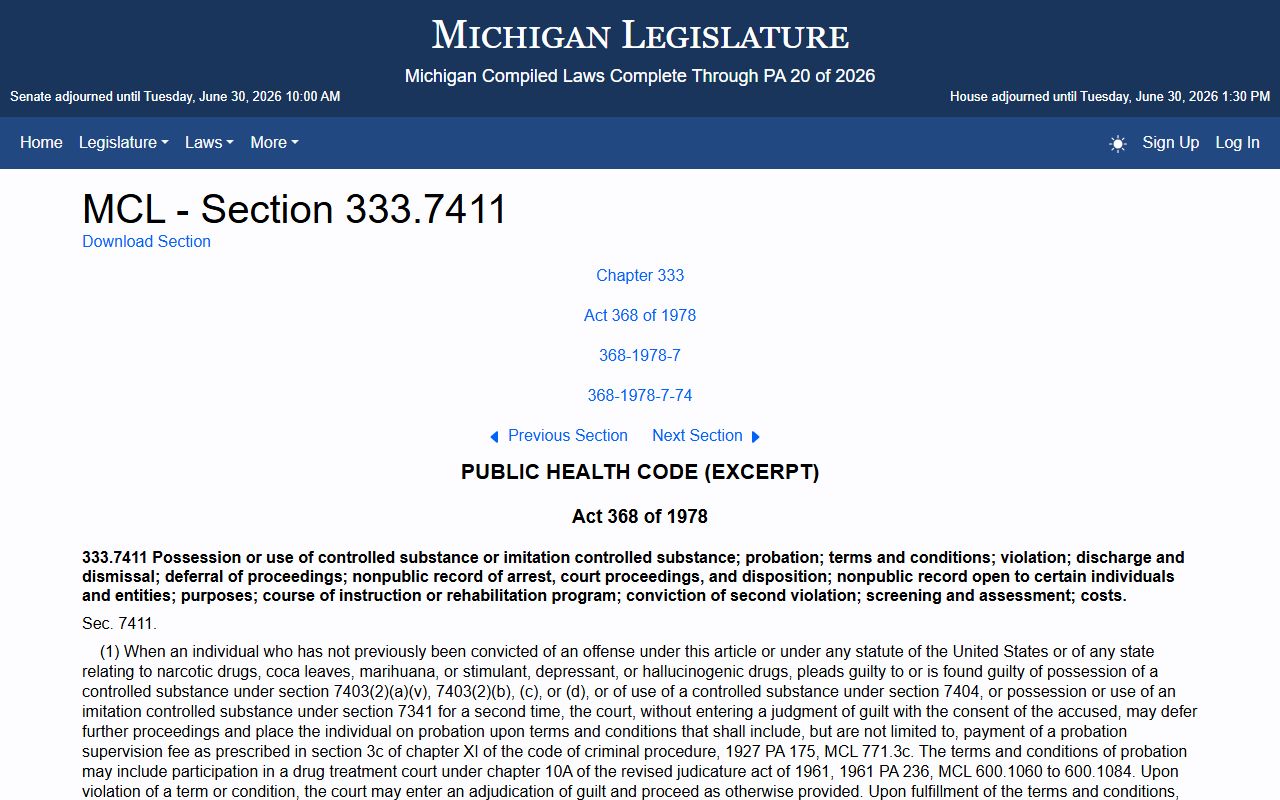
That statute shapes how some Iosco County criminal court records show a drug charge that never became a formal conviction.
Sealed vs. Expunged Records
Michigan does not use the word sealed the way some states do. Its main tool is the set-aside, which clears an eligible conviction from the public record. A set-aside is close to what most people call an expungement. The set-aside law, MCL 780.621 and the sections that follow, sets who qualifies and how long they must wait.
The waiting periods run from the sentence or the end of any jail term, and MCL 780.621d spells out how long each type of conviction must wait.
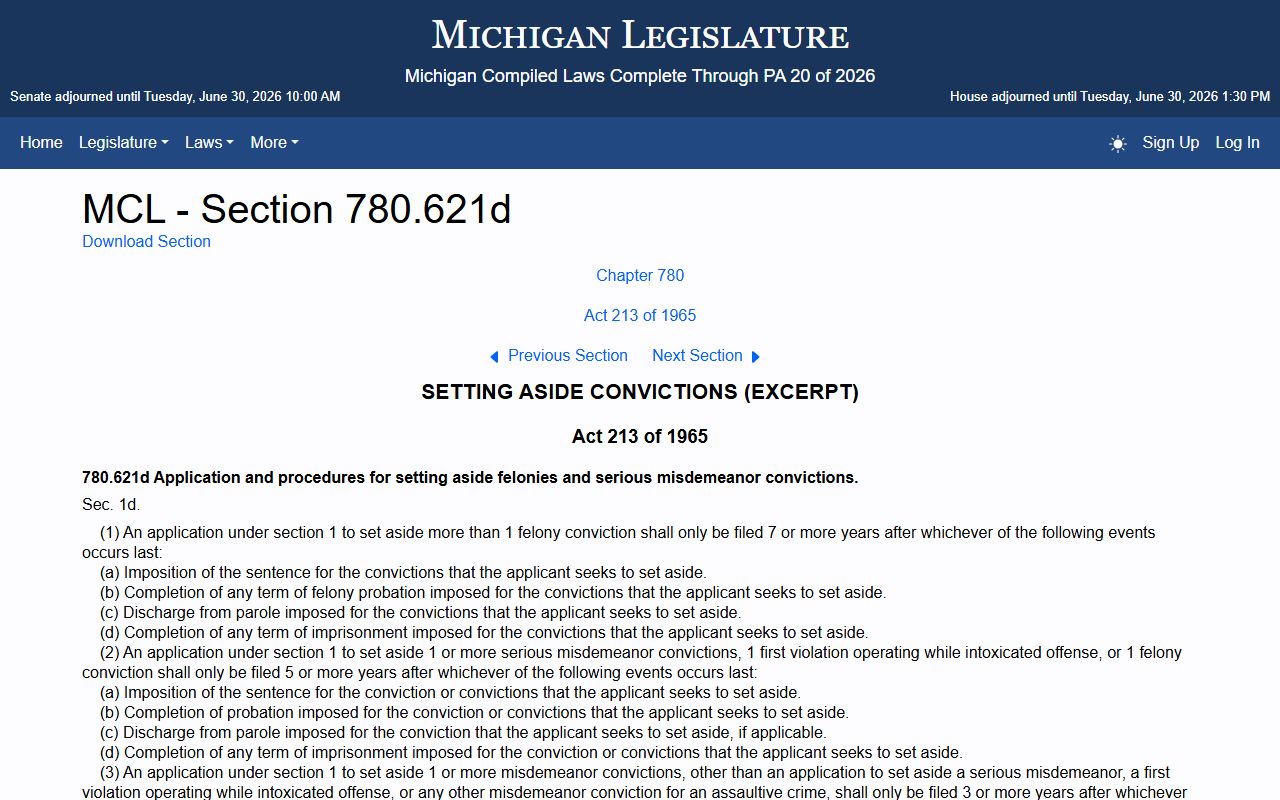
Those timelines decide when an Iosco County criminal court record can be set aside on request. Michigan now also grants some set-asides automatically, so certain misdemeanors and lower-level felonies clear on their own once the waiting period passes and the person stays clear of new trouble.
| Sealed | Expunged | |
|---|---|---|
| Visibility | Hidden from public view | Set aside and removed from the public record |
| Law Enforcement | Limited access | Kept for narrow court and police use |
| Eligibility | Rare, by specific court order | Many convictions after the waiting period, by petition or automatically |
Public Access to Iosco County Criminal Records
Michigan treats court records as open in principle. Court Rule MCR 8.119 puts the clerk in charge of the files and sets how the public may reach them. Criminal case files stay public unless a statute or a court order closes them. When a record is not posted online, the county's Freedom of Information Act process gives a formal way to request it from the office that holds the file. The Iosco County Clerk publishes its own FOIA forms and a five-business-day response rule for that purpose.
Key Statutes:
Michigan FOIA (MCL 15.231) - the formal request process for court or county records that are not available online.
Michigan Court Rule MCR 8.119 - places case files with the clerk and sets the terms for public inspection and copying.
Note: A public case search may show the docket and some documents, but the full Iosco County criminal file can require clerk contact or a records request.
Background Check Considerations
A casual case-search lookup is not the same as a background check. Employers, landlords, and licensing bodies that run formal checks must follow the federal Fair Credit Reporting Act. That law sets rules on accuracy, notice, and the right to dispute a result. A single Iosco County criminal court record found online may be incomplete, out of date, or tied to the wrong person. It should be confirmed with the clerk before anyone relies on it for a decision.
Important: This website is not a consumer reporting agency under the Fair Credit Reporting Act, and its records may not be used for employment, tenant, credit, or licensing decisions.
Restricted Criminal Court Records in Iosco County
Some criminal records in Iosco County stay closed. Juvenile cases carry the strongest protection. Michigan law, MCL 712A.28, limits who may see juvenile court files, and much of that record stays out of public view. Sealed cases, set-aside convictions, and ongoing matters may also be hidden. Non-public cases will not appear in the online portals, which is a design choice, not a search error.
Michigan's automatic set-aside statute, MCL 780.621g, directs the state to clear eligible convictions without a petition.
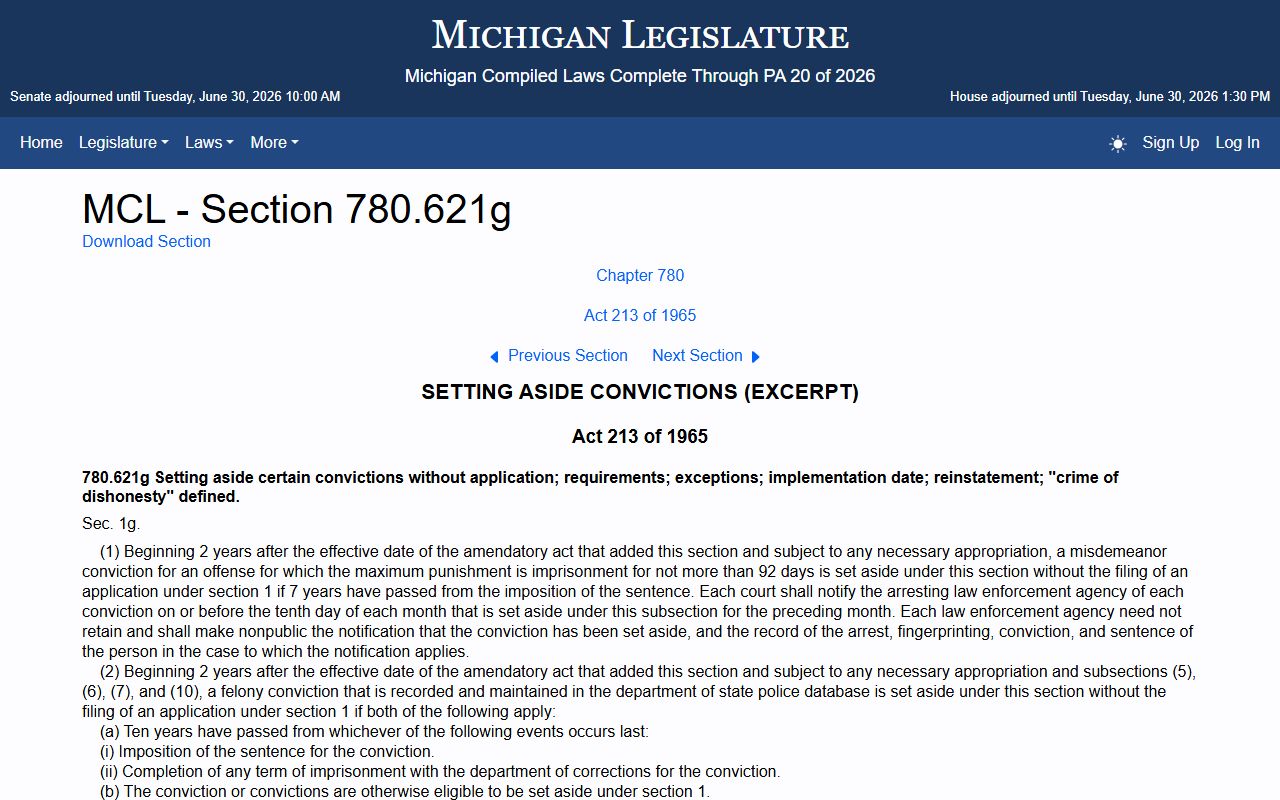
Once that happens, the conviction drops out of the public Iosco County criminal court records, though limited court and police access remains. For anything the portals will not show, the path runs through the court office or a FOIA request. Broader searches across every case type sit in the wider Iosco County court records collection.