
What Iosco County Probate Court Covers
The probate side of the court handles what happens to a person's property and legal status after death or during incapacity. That includes decedent estates, trust proceedings, and rights to intestate estates. Files may run as informal proceedings, unsupervised formal proceedings, or supervised proceedings, depending on how much court oversight a case needs. Small estates valued under $20,000 can move through a petition for assignment, a faster route than a full estate case. The court also handles petitions for hospitalization of mentally ill persons, adult and minor name changes, and guardianships and conservatorships for minors and adults, including adults with developmental disabilities. Limited guardianship of a minor is a further option families use.
The family division of the same court reaches deep into personal and juvenile matters. It hears divorce, custody, parenting time, and support. It also handles paternity, adoptions, name changes, juvenile proceedings, neglect and abuse cases, emancipation of minors, and personal protection matters. Because one bench oversees both halves, a single family may touch the probate side and the family side within the same courthouse. That mix is why probate records here are not just wills and estates. They cover a wide slice of county life.
Judge Christopher P. Martin presides over the Probate and Family Court, and Mary Windsor serves as Probate Court Administrator and Register. The office keeps standard weekday hours in Tawas City. Some hearings are held remotely through Zoom, so a case notice may point a party to a video link rather than a courtroom seat. Anyone with an active case should check the notice for the hearing format before the date.
Probate Terms Defined
Probate paperwork leans on a handful of legal words that decide who acts and who inherits. A quick read of the core terms makes an estate or guardianship file far easier to follow. The short glossary below covers the words that show up most often in Iosco County probate filings.
- Testator
- The person who made a will. When that person dies, the will is filed and reviewed by the probate court.
- Executor
- The person named in a will to carry out its terms, gather assets, pay debts, and distribute what is left. Michigan often calls this role a personal representative.
- Intestate
- Dying without a valid will. State law then decides who has the right to the estate, which the court handles as a right to an intestate estate.
- Guardianship
- A court order giving one person authority to make personal and care decisions for a minor or an adult who cannot decide for themselves.
- Conservatorship
- A court order placing another person in charge of the money and property of someone who cannot manage their own finances.
- Register
- The probate court officer who accepts filings, signs certain informal orders, and keeps the estate and guardianship records for the county.
How to Search Iosco County Probate Records
Probate and family cases in the county feed into Michigan's statewide case-search system. The county routes probate lookups through a dedicated court path, and the same system also carries civil, criminal, and traffic files from other courts. Public search scope depends on the case type, so an open estate may show more detail than a shielded juvenile or family file. When a record is not visible online, the office phone line and an in-person visit remain the reliable fallback.
To run an online lookup, start with the county probate route into the case-search tool, then widen out to the full statewide search if you need more.
- Open the county probate case-search route at micourt.courts.michigan.gov/case-search/court/P35 to focus the search on Iosco County probate and family cases.
- Search by party name or case number, then review the returned case list for the file you want.
- For a wider check across other courts, use the statewide MiCOURT case search, which can surface case information, documents, orders, and opinions depending on the court.
Note: Sealed estates, juvenile files, and many family-division matters will not appear in a public search, so a call or office visit is often the only route to confirm them.
Iosco County Probate & Family Court Office
The Probate and Family Court sits inside the county courthouse complex on West Lake Street in Tawas City, the same block that houses the circuit and district courts. Judge Christopher P. Martin leads the court, with Mary Windsor as its administrator and register. The office answers questions about estate filings, guardianship petitions, name changes, and family and juvenile cases, and it can tell a caller whether a hearing will be in person or by Zoom.
Iosco County Probate & Family Court
422 W. Lake St.
PO Box 609
Tawas City, MI 48763
(989) 362-3991
Fax: (989) 984-1035
Mon-Fri 8:30am-4:30pm
Parties scheduled for a remote hearing should read the county Zoom instructions ahead of time, since they explain how to join and when to log on. Adoption, name-change, and marriage-license age questions also come through this same office, which is why the county's marriage-license page sends young applicants here for consent matters.
Iosco County Probate Filing Fees
Most Michigan probate filing fees are fixed by state statute rather than set locally, so the exact charge for opening an estate or filing a guardianship petition should be confirmed with the court before you file. The $20,000 figure tied to a petition for assignment is a value threshold that decides which small-estate route applies, not a fee. For anyone who cannot afford court costs, the state fee-waiver form removes that barrier, and the county offers an online portal for probate and juvenile payments.
| Item | Amount / Route |
|---|---|
| Decedent estate filing fee | Set by state statute; confirm with the court |
| Guardianship or conservatorship petition | Set by state statute; confirm with the court |
| Certified copies | Confirm current per-item rate with the court |
| Fee waiver (Form MC20) | No fee; file if you cannot afford costs |
| Probate / juvenile payments | Online through the county payment portal |
The fee-waiver request, state form MC20, lets a person ask the court to suspend fees and costs based on income. To pay a fee or a court-ordered cost online, use the county's probate and juvenile payment page at GovPayNow, which asks for the payer's first, middle, and last name, the case number, and a phone number. Not every charge can be paid online, so keep the case number handy and call the court if the portal does not show your balance.
Iosco County Probate and Family Court Forms
The court's forms page gathers the paperwork the office expects for probate, juvenile, and family cases. General filings rely on State Court Administrative Office (SCAO) forms, plus a fee-waiver request, a request for a court-appointed attorney, and a request for a transcript. Beyond estates, the forms set reaches into delinquency, neglect and abuse, and adoption work, which underlines how broad this court's docket is.
- SCAO-approved probate and estate forms for opening and administering a case.
- Fee-waiver request and request for a court-appointed attorney.
- Request for a transcript of a hearing or proceeding.
- Juvenile delinquency forms, including probation terms and requests for review.
- Neglect and abuse advice-of-rights forms filed at the start of a new case.
- Adoption forms, including a release of information for Michigan adoption records.
The full inventory lives on the county's probate court forms page, where each document can be downloaded and printed before a filing. Picking the correct form up front spares a return trip, since the office cannot give legal advice on which one fits a given situation.
What Iosco County Probate Records Show
An estate file grows as a case moves forward, and each stage adds documents to the record. Early on, the file holds the petition to open the estate, the will if one exists, and the order naming a personal representative. As administration continues, the record can include an inventory of assets, accountings that track money in and out, claims from creditors, and the final order that distributes what remains to heirs or devisees.
Guardianship and conservatorship files follow a different arc. They show the petition, any medical or evaluation reports the court reviews, the letters of authority granted to the guardian or conservator, and later reports on the protected person's care or finances. Name-change files carry the petition, notice, and the signed order. Because the family division shares the bench, some records touch adoption, juvenile, or personal protection matters, and those are held to tighter access rules than an ordinary estate.
Not every part of a file is open to walk-in review. Some documents live only in the paper court file, while others surface through the statewide case search. When the online result stops short of what you need, the register's office can confirm what the file holds and how to request a copy.
Restricted Probate and Juvenile Records
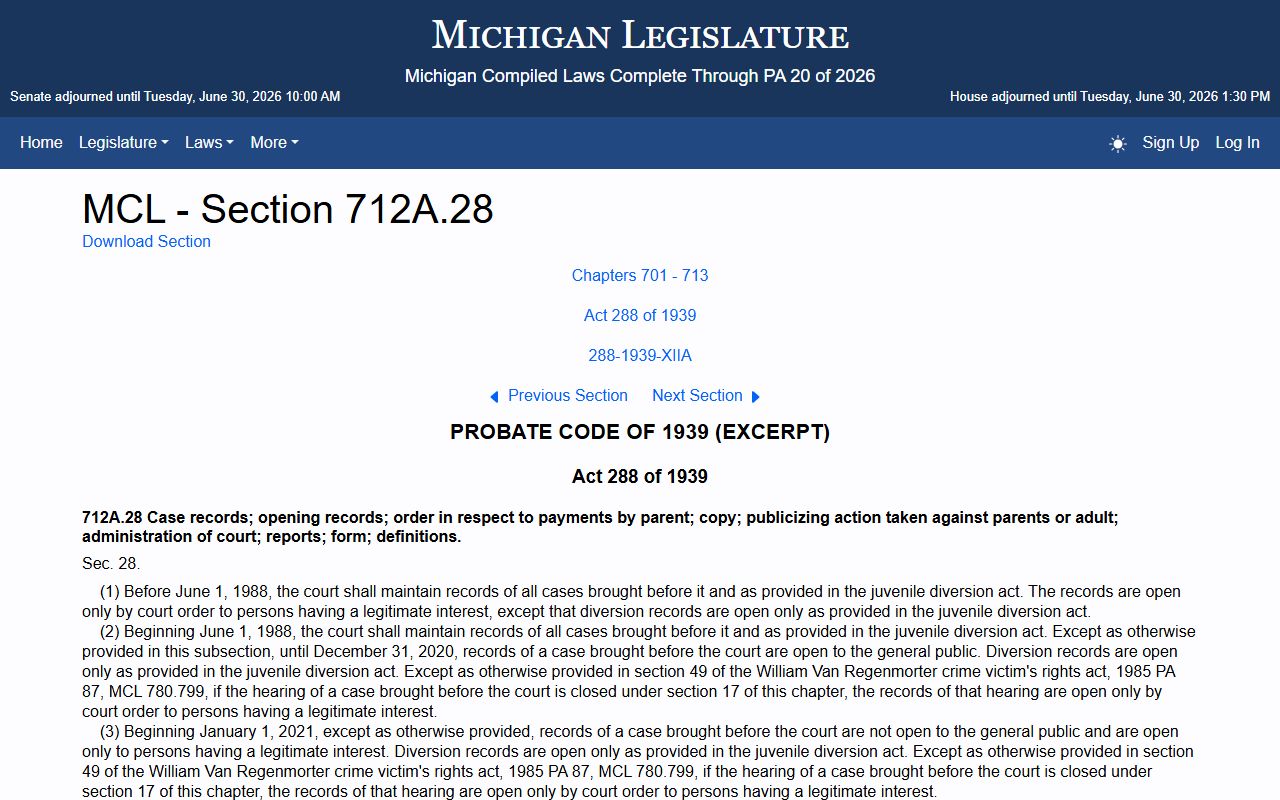
Public access to probate records has real limits, and juvenile files sit behind the strongest of them. Michigan law restricts who may see a juvenile record, and much of what the public can view is controlled by court order rather than open by default. That is why the county keeps delinquency, neglect, abuse, and adoption materials on a separate track from ordinary civil forms. A parent, guardian, or attorney with standing may reach these files, but a general public search will not.
The controlling rule for juvenile record access appears in MCL 712A.28, which frames how these records are kept and shared. The statute page below is the primary source on that limit.
Sealed estates, adoption records, and mental-health commitment files carry similar shields. For any of these, the right move is to contact the register's office directly or work through an attorney rather than expecting a full file from an online lookup. Certified copies of vital records connected to a family case, such as a divorce, sit with the county clerk instead, a split explained on the Iosco County marriage and divorce records page. When a record is truly private, the court will say so, and no public portal will show it.