
Iosco County District Court Overview
The 81st District Court handles the daily legal traffic of Iosco County. Its docket runs on volume. Speeding tickets, seat belt violations, and other traffic citations all land here. So do landlord and tenant disputes, small claims, and most misdemeanor charges. When police make a felony arrest, the first hearings still start in this court before the case moves up. Judge Christopher P. Martin presides over the district bench, and he also serves the county's probate and family division.
Two Michigan statutes set the court's reach. Under MCL 600.8301, the district court holds exclusive civil jurisdiction over money claims up to $25,000. MCL 600.8311 gives it authority over misdemeanors, civil infractions, and the early stages of felony cases. Those limits explain why a small traffic fine and a large lawsuit end up in different courtrooms. The state legislature posts the full text of the civil-jurisdiction rule for anyone to read.
The dollar cap on district civil cases is written directly into Michigan Compiled Laws section 600.8301, shown below.
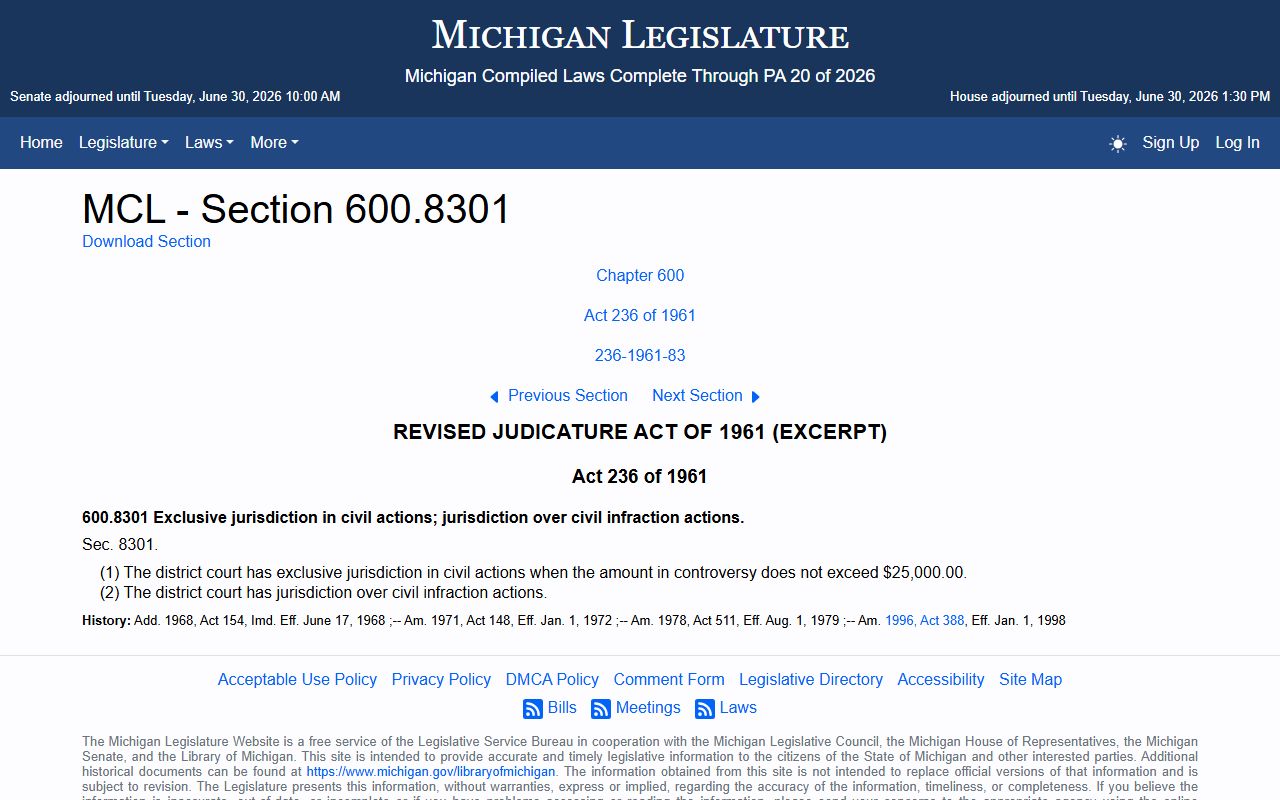
Anything above that figure belongs to the circuit court instead. That single line keeps the two dockets from overlapping and tells you which office to call first.
For most county residents, the district court is the court they will meet. A ticket, a security-deposit fight, or a first misdemeanor almost always opens here. The county's own courts page frames the 81st District Court the same way, listing traffic violations, landlord-tenant disputes, small claims, misdemeanors, and felony preliminary hearings as its core work. That practical role is why its records draw steady public searches.
Iosco County District Court Staff and Contacts
The court runs with a small, named staff, which makes phone calls easy to route. One judge sits on the district bench. A magistrate handles many of the quick, front-end matters. Each clerk owns a specific case type, so knowing the roles saves time when you dial the office. The table below lists who does what inside the 81st District Court.
| Role | Name |
|---|---|
| District Judge | Christopher P. Martin |
| Magistrate / Court Administrator | Brian Harger |
| Deputy Magistrate / Criminal Clerk | Laura Kruse |
| Traffic Clerk | Teri Hill |
| Civil Clerk | Julie Quarters |
| Bookkeeper / Assignment Clerk / Jury Manager | Sam VanAlstine |
The office keeps standard county hours and sits in the courthouse complex on West Lake Street. Use the mailing box for payments, forms, or written requests sent by mail.
81st District Court
422 W. Lake St.
PO Box 609
Tawas City, MI 48763
Phone: (989) 362-4441
Fax: (989) 984-1021
Monday-Friday, 8:30am-4:30pm
Note: Call the traffic clerk for citation questions and the criminal clerk for misdemeanor cases, since split duties mean the right person answers faster.
District Court, Circuit Court, and Probate Court
Michigan gives each trial court a clear lane. The district court takes the smaller and faster cases. The circuit court takes the serious civil and felony work. The probate and family court handles estates, guardianships, and family matters. The chart below shows how the three courts split the county's caseload.
| District Court | Circuit Court | Probate & Family Court | |
|---|---|---|---|
| Civil Limit | Up to $25,000 | Over $25,000 | Estate & guardianship |
| Criminal Jurisdiction | Misdemeanors, traffic, civil infractions, felony preliminary exams | Felonies & serious misdemeanors | Juvenile delinquency |
| Small Claims | Yes | No | No |
| Appeals | To circuit court | From district court | — |
Small claims is the clearest divide. Only the district court runs a small claims path, where people settle low-dollar disputes without a lawyer. Felony charges start in district court but do not stay there. Once the case clears its first stage, it moves to the circuit court for trial. Family and estate files follow a separate track through the probate and family division.
How a Case Moves Through the District Court
Cases follow a set path, and the path depends on the charge. A criminal case opens with an arrest or a written citation. Then the court sets an arraignment, where the judge or magistrate reads the charge and sets bond. A civil case starts when one party files a complaint. The two flows below show the usual order of steps.
Criminal flow: Arrest or Citation › District Court Arraignment › Pretrial › Trial or Plea › Sentencing
Felony charges add an extra stage. After the arraignment, the district court holds a preliminary examination to test the evidence. If the proof is strong enough, the judge orders a Preliminary Examination › Bindover to Circuit Court, and the case leaves the district level for good.
Civil flow: Complaint Filed › Answer › Discovery › Trial › Judgment › Appeal to Circuit Court
Most cases end well before trial. Traffic tickets often close with a paid fine or a short hearing. Small claims cases can settle in a single visit. When a party disagrees with the outcome, the appeal runs up to the circuit court, not sideways to another district.
Iosco County District Court Divisions
The court splits its work into a few practical lanes, each with its own clerk. Traffic is the largest by count. Criminal covers misdemeanors and the early felony steps. Civil covers money claims, landlord-tenant cases, and small claims. Fines and costs are handled through an online payment vendor, which is also the clearest public window into a district case.
- Traffic: speeding, seat belt, and other moving and non-moving citations
- Criminal: misdemeanors, arraignments, and felony preliminary hearings
- Civil: claims up to $25,000, landlord-tenant, and small claims
- Payments: court-ordered fines and costs by name, birth date, citation, or case number
The district court's fines and costs run through the GovPayNow payment portal, where a search doubles as a public lookup.
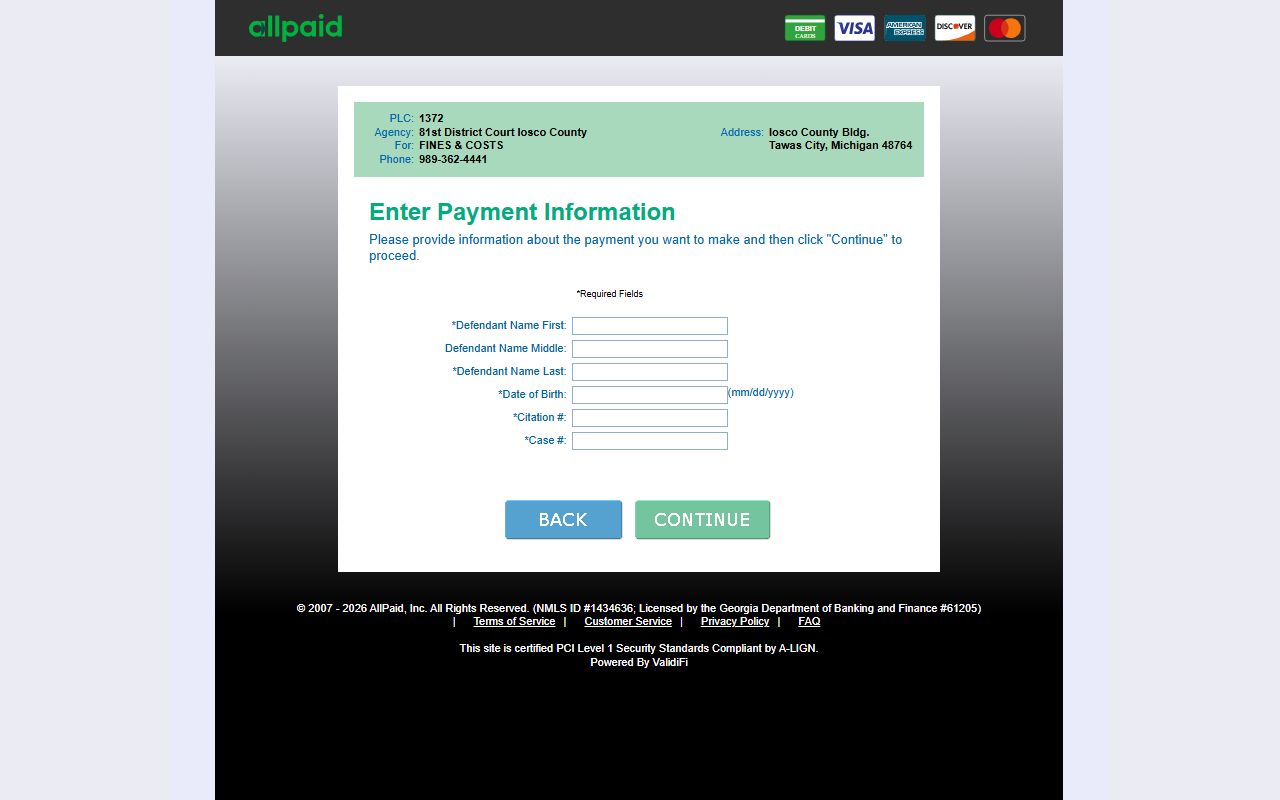
The portal lets you search by defendant first, middle, and last name plus date of birth, or by citation number or case number. It covers fines and costs only, and non-public cases are excluded by design. For broader case detail, the statewide MiCOURT case search and the county's own district court page point toward the same records. Traffic filers who want the full ticket-to-payment loop can also review the Iosco County traffic court records path.
Landlord-tenant and small claims cases run through the civil clerk. Small claims lets a person sue for a limited amount without a lawyer, and the hearing is short and informal. Landlord-tenant matters cover eviction and unpaid-rent disputes, which move quickly under Michigan's summary-proceedings rules. Both types settle inside the same courthouse office that logs traffic and misdemeanor files, so one phone number reaches the whole civil side.
The 81st District Court Within the 23rd Circuit
The 81st District Court does not stand alone. It sits under the 23rd Judicial Circuit, which covers Alcona, Arenac, Iosco, and Oscoda counties with a single circuit judge. When a felony clears its preliminary examination in Tawas City, the file is bound over and the circuit court takes it from there. Serious civil suits above the district limit also open at the circuit level. The 23rd Circuit runs with one judge across all four counties, so hearing dates and dockets are shared regional resources rather than local ones.
Appeals follow the same upward path. A person who loses a district case can ask the circuit court to review it. That structure keeps the district court focused on high-volume, lower-stakes matters while the heavier cases move up. The county's Iosco County circuit court page covers felony trials, domestic cases, and the appeal route in more detail.
Note: Felony records may appear under both courts, so a case that starts in district court can finish under a circuit case number after bindover.
Searching Iosco County District Court Records
Michigan does not use justice of the peace courts or separate county courts. The district court is the ground floor, and the magistrate handles much of its front-end work. In the 81st District Court, Magistrate and Court Administrator Brian Harger takes on arraignments, civil infractions, small claims hearings, and warrant review. Deputy Magistrate Laura Kruse shares that load on the criminal side. There is no lower court beneath the district level to check.
Records searches start with the case type. Traffic and misdemeanor fines are easiest to find through the payment portal. Full case status often needs a call to the correct clerk or a look through MiCOURT. Non-public cases will not appear in the online tools, and that block is deliberate rather than an error in your search.
The district court page also links a resource for automatic record cleanup. Under Michigan's set-aside law, MCL 780.621, some old convictions clear on their own or through a petition. Anyone tracing a stale misdemeanor should check whether the record has already been set aside before assuming it still shows. For the underlying charge detail behind a case, the Iosco County criminal court records page maps the full file.
Can I pay a district court fine online? Yes, for most public cases. The GovPayNow portal accepts fines and costs by name and birth date, by citation number, or by case number. Payments post after processing, and balances can lag for a day or two. If the case is sealed or non-public, the portal will not show it, and a call to the office is the next step.